Sunday, October 18, 2009

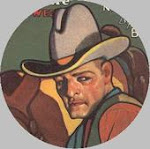
Fargo by John Benteen


Fargo is a character from the near-end of the wild western era, operating during the Mexican-American War, playing gun-runner or troubleshooter for whomever will pay him to do the dirty work.

Fargo (New York: Belmont Tower Books, 1971) is the first in this series. Hard-boiled, muscular, manly -- there's as much sentiment in these stories as Fargo has fat registering in his body mass index. Imagine Lee Marvin in a southern Texas-northern Mexican setting with a bandoleer of brass cartridges, bristling with arms like a rabid porcupine is prickly with barbs. Without using Lee Marvin's name, that's pretty much how the author -- Ben Haas, masked by the John Benteen pseudonym -- describes his anti-hero.

In this opening novel, Neal Fargo jumps right in on the Pancho Villa revolution, setting out to help some Yankees haul a pack-mule train of silver from their mine before the revolutionaries grab it. On the way, he encounters a sadistic Spanish land owner, some beautiful women, and some double-crossing Americans.

There's plenty of action, and the pace is quick, full of action. Reading this story is so manly you just want to build a fire and grill a steak and drink a beer with a tequila chaser while you turn the pages.

Friday, October 2, 2009

Stouthearted Men by R.C. House


New York: Pocket Books, 1995.

Finding on a used bookstore’s shelves a western by R.C. House that I haven’t yet read is a pleasure. I rather broadly categorize westerns into those focused on action and those focused on storytelling. The two categories don’t have to be mutually exclusive, but House’s novels I usually place in the Storytelling bucket.

There can be plenty of action in a Storytelling-focused western. For example, I’d place the O. Henry story about the Cisco Kid, “The Caballero’s Way,” in the Storytelling category, but while the yarn-spinning and attention to language is an important part of the tale, there’s plenty of murderous action in the story.

There’s action in Stouthearted Men, but clearly House loves the play with words, just as I note in my post about O. Henry’s story. The roll out of of the plot and action is far more leisurely than one would encounter in a paperback original from the Gold Medal, Ace, and Signet era of the late 1950s up through the '60s. House focuses on characters, their quirks, their ways of speech, and brings a smile or a frown as appropriate. The opening paragraph of Stouthearted Men:

"A killer and pillager deluxe named Bad-Face Ike Bodene broke jail for the second time and is on the prod. That's why I called together this posse commitatus of stout-hearted men. There'll be six of us against about three to one odds."

House can demonstrate a bit of the poet's DNA as well:

With dawn, night clouds turned themselves into glorious smears of rose paint against a gray sky fast ripening to a rich blue along the eastern horizon. Close to the still-dark land, silhouetted forms of six mounted figures loomed black as paper cutouts against the dim of daybreak, their heads bobbing sleepily on the trail out of Fort Walker.

I had the pleasure of making R.C.'s acquaintance through the miracle of e-mail, thanks to a virtual introduction by Robert Randisi. We corresponded a few months before he died. It was a pleasure to know him slightly before his death. It's a pleasure to read one of his books for the first time.

Monday, September 28, 2009

Limbo Pass by Marshall McCoy


Published in New York (Bantam, 1968).

Leonard Meares
was quite a writer of westerns, under a variety of pseudonyms. The Larry and Stretch series, which may run up to 400 novels, is very entertaining – action and humor combined into each novel quite comfortably. I’ve read several of the Larry and Stretch novels and enjoyed each one.

The Nevada Jim – or Big Jim – series, published under Meares’ Marshall McCoy pseudonym, had intrigued me for several years, primarily because the Jim Bama cover paintings for the Bantam reprints of this Australian series had caught my attention. Finally I read an entry in this series, Limbo Pass. As anticipated, it was very enjoyable.

The humor that marks the Larry and Stretch series isn’t so obvious here. Instead, the focus is on action and drama arising from character conflicts. This novel, published as number 3 in the Bantam series, makes clear about Jim Gage’s Army background and his search for the man who murdered a friend. This sets up a good reason for Big Jim to roam from town to town for each novel’s setting. Another big character, Cheyenne Bodie, played by big Clint Walker on TV, roamed from place to place for each episode, but rarely had a good reason for doing so except in the first few episodes, when Cheyenne was helping with a scouting and surveying mission for the U.S. Army.

Picturing Clint Walker as Jim Gage is easy to do, thanks to Meares’ description of the character.

In this particular novel, Jim joins a posse after a gang of bank robbers who cold-bloodedly shoot down a few citizens during the course of the robbery. The antagonism among some of the posse members, plus the deadly ambushes executed by the robbers as they make their escape, set up the conflicts that make this short novel (only 90 published pages) a quick and satisfying read. Reading it is much like watching an episode of one of the Warner Brothers western TV shows from the 1950s: action, drama, all wrapped up quickly and satisfyingly by the final credits.

Saturday, August 1, 2009

O. Henry introduces the Cisco Kid

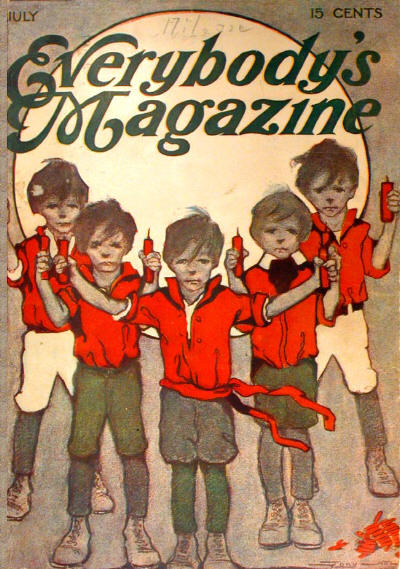
"The Caballero’s Way,” by O. Henry (William Sydney Porter), 1904. [The Mammoth Book of The Western says 1904, but the FictionMags index lists this story as first appearing in Everybody’s Magazine {v17 # 1} July 1907. Expert info requested and welcomed.]

Xenophobia, in our politically correct culture, has been charged against anyone protesting against providing the rights of U.S. citizens to those who cross its borders illegally. I mention this not to stir up political debates, but to note that crossings at the border between Mexico and the United States have been a contentious issue back to the time of the Lone Star Republic and before. How many western movies and stories have dealt with villains escaping U.S. authorities by crossing the Rio Grande? How many have told tales of renegades from south of the border coming north to rustle cattle or steal lives? The Border has always been a volatile demarcation in politics, real life, legend, and storytelling.

“The Caballero’s Way” takes place in Texas, north of the Rio Grande near the Frio River -- but O. Henry invests this story with all the mythic freight of Border Story, along with the effervescent delight in language that marks so many of William Sydney Porter’s tales.

This story, which introduces Cisco Kid, presents a figure quite different from the character we know from Hollywood -- the latter a clean cut, chivalrous and charming rogue. O. Henry’s Cisco Kid is a cold-blooded killer, a non-Hispanic sociopath who rides a horse, and the story’s climax hammers this point home even more strongly than the several thousand words leading up to the end.

And those words! Porter must have found a delight in language that only can compare to a youngster’s delight at being told he can eat his fill in an ice cream shop with no regrets. Here, for a sample taste, take a look at the first paragraph:

The Cisco Kid had killed six men in more or less fair scrimmages, had murdered twice as many (mostly Mexicans), and had winged a larger number whom he modestly forbore to count. Therefore a woman loved him.. . . .

. . . and and third . . .

Tonia Perez, the girl who loved the Cisco Kid, was half Carmen, half Madonna, and the rest—oh, yes, a woman who is half Carmen and half Madonna can always be something more—the rest, let us say, was humming-bird. She lived in a grass-roofed jacal near a little Mexican settlement at the Lone Wolf Crossing of the Frio. With her lived a father or grandfather, a lineal Aztec, somewhat less than a thousand years old, who herded a hundred goats and lived in a continuous drunken dream from drinking mescal. Back of the jacal a tremendous forest of bristling pear, twenty feet high at its worst, crowded almost to its door. It was along the bewildering maze of this spinous thicket that the speckled roan would bring the Kid to see his girl. And once, clinging like a lizard to the ridge-pole, high up under the peaked grass roof, he had heard Tonia, with her Madonna face and Carmen beauty and humming-bird soul, parley with the sheriff's posse, denying knowledge of her man in her soft mélange of Spanish and English.

Oh heck, here’s the sixth paragraph too, it’s so short:

Six feet two, blond as a Viking, quiet as a deacon, dangerous as a machine gun, Sandridge moved among the Jacales, patiently seeking news of the Cisco Kid.

The words roll along with that edge of humorous exaggeration that acts as verbal legerdemain to distract you from the dangerous knife edge of the Cisco Kid’s homicidal tendencies and Ranger Sandridge’s deadly sober responsibility as enforcer of the law. The mixed humorous/deadly quality of the narrative is a mark of the traditional western. For example, only recently I read a more contemporary western short story, “The Bandit,” by Loren D. Estleman, that demonstrates this same narrative balancing act. Published in 1986, the author describes a man released from prison in 1906 after being captive 29 years:

Jubal smiled. His teeth were only a year old and he was just a few months past grinning like an ape all the time.

The synchronal picture of a smiling primate and a death’s head rictus is sharp when considered as a foreshadowing of the tale’s end. Like Porter, Estleman is a master storyteller. In “The Caballero’s Way,” Porter disguises the deadly seriousness at the core of this story just as the Cisco Kid masks the ice of his heart with his charm and smile.

The story itself, stripped of its colorful word play and its climactic, obligatory O. Henry twist, offers little that a fan of western fiction or song hasn’t encountered hundreds (if not thousands) of times. But the story’s marvelousness is all in its telling -- here, as in nearly every mature tale by Porter, the storyteller is the star. But isn’t that true of most of the genre stories we fondly recall? Some other writer could tell the same story, but the end result would be far different, because the magic of “The Caballero’s Way” resides in how Porter tells the tale.

If someone already has written an article describing how O. Henry’s blue-eyed murderer was transformed by Hollywood, radio, and comics into a Western Robin Hood, I’d like to know about it to find out more.