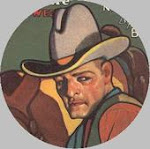
This is a nice, solid western
by the always-dependable Ben Haas, under one of his
pseudonyms. (Well, I've always found him dependable -- I don't think
I've read any of his books yet that I've not enjoyed.)
The
Mustang Men is an entry in Haas' Rancho Bravo series. It's
the first of them I've read, and it was quite good.
My main
point in the post is to share the cover. I think it's very evocative
for a western cover painting. The impressionistic style reminds me
greatly of Jeff Jones' work, but I don't find a tell-tale signature.
Nor did I think he worked in the western genre, but I may be
wrong.
Anyone know who did this cover painting?
Thursday, April 19, 2012
Monday, December 26, 2011
Criminous Haiku on The 5-2
The week of December 26, the crime poetry site The 5-2 is featuring a haiku I wrote. Besides being a haiku about crime, it has a seasonal/holiday slant.
Gerald So, who edits The 5-2 site, posts a new crime-associated poem each week. Gerald is a member of the Academy of American Poets, his poems have appeared in Nerve Cowboy, Barbaric Yawp, Defenestration, Cherry Bleeds, Yellow Mama, Gutter Eloquence Magazine and other provocatively-named venues. He broadcast an invitation for holiday-themed submissions, and I responded. I'm not sure how many weeks he has set aside for the holiday poetry, but I was pleased to receive his acceptance. Gerald also posted his reading of the poem. It's haiku, so don't worry -- it's short.
Tuesday, November 15, 2011
Have Gun, Will Travel by Noel Loomis
I found this TV-show tie-in novel at PulpFest this summer. It seemed a happy coincidence: Our family has been watching, off and on, seasons' worth of episodes of the show for the past three years thanks to through-the-mail rentals of DVDs and streaming video online. I had no idea a tie-in novel existed for Have Gun, Will Travel, so I was pleased to delve in to see how the prose Paladin compared to the phosphor-dot Paladin; and the book gave me the opportunity to finally read a western by Noel Loomis.
Just as most of the episodes begin in San Francisco, so does this novel. The first several chapters, in fact, take place there as Paladin encounters a flamboyant actress and some menacing gents who seem to follow Paladin and the actress around but demonstrate no clear association with the woman. This bit of mystery stirs Paladin's attention, of course, as does the seeming connection between the actress' recent visit to Santa Fe and a request for Paladin's help that originates from that same town.
A foiled stage coach robbery, a run-in with attacking Indians and a chase by Mexican bandits all seem somehow connected to Paladin when he learns that the woman who has requested his help—Mrs. Marsh—wants him to find her husband. The husband, Joe, runs a newspaper in Santa Fe, but has stirred up suspicion against a local rancher, Whipple, by accusing him of gun running to Mexican revolutionaries. Joe has disappeared in Mexico, supposedly joining the revolutionaries there. Paladin finds all this somewhat confusing, since Mrs. March apparently loves her husband, but allows Whipple to court her.
A trip into Mexico turns deadly as Paladin joins a revolutionary camp and finds Joe Marsh. The latter is an idealist who imagines the revolutionaries will bring freedom to Mexico, but he is blind to the ugly banditry demonstrated by his fellows.
Paladin ties up all the loose ends by the last page, of course.
Loomis captures the onscreen persona of Paladin very well. I could easily imagine some of the dialog as spoken by Richard Boone in his black attire. There are, of course, the spot-on moments of Paladin demonstrating his higher learning and his sardonic commentary on the activities of his companions—both the apparent good guys and and obvious bad guys.
Whether this is a good sample of Loomis' work is hard to say: work-for-hire tie-ins don't necessarily show off a writer's typical style or concerns, but one can easily argue that a given writer would be chosen for a project because his style and concerns closely match those of the property for which he would be writing a novel. I suppose I'll have to read more by Loomis to find out whether that's true.
Just as most of the episodes begin in San Francisco, so does this novel. The first several chapters, in fact, take place there as Paladin encounters a flamboyant actress and some menacing gents who seem to follow Paladin and the actress around but demonstrate no clear association with the woman. This bit of mystery stirs Paladin's attention, of course, as does the seeming connection between the actress' recent visit to Santa Fe and a request for Paladin's help that originates from that same town.
A foiled stage coach robbery, a run-in with attacking Indians and a chase by Mexican bandits all seem somehow connected to Paladin when he learns that the woman who has requested his help—Mrs. Marsh—wants him to find her husband. The husband, Joe, runs a newspaper in Santa Fe, but has stirred up suspicion against a local rancher, Whipple, by accusing him of gun running to Mexican revolutionaries. Joe has disappeared in Mexico, supposedly joining the revolutionaries there. Paladin finds all this somewhat confusing, since Mrs. March apparently loves her husband, but allows Whipple to court her.
A trip into Mexico turns deadly as Paladin joins a revolutionary camp and finds Joe Marsh. The latter is an idealist who imagines the revolutionaries will bring freedom to Mexico, but he is blind to the ugly banditry demonstrated by his fellows.
Paladin ties up all the loose ends by the last page, of course.
Loomis captures the onscreen persona of Paladin very well. I could easily imagine some of the dialog as spoken by Richard Boone in his black attire. There are, of course, the spot-on moments of Paladin demonstrating his higher learning and his sardonic commentary on the activities of his companions—both the apparent good guys and and obvious bad guys.
Whether this is a good sample of Loomis' work is hard to say: work-for-hire tie-ins don't necessarily show off a writer's typical style or concerns, but one can easily argue that a given writer would be chosen for a project because his style and concerns closely match those of the property for which he would be writing a novel. I suppose I'll have to read more by Loomis to find out whether that's true.
Labels:
Have Gun Will Travel,
Noel Loomis,
Paladin,
Richard Boone
Saturday, October 22, 2011
Noel Loomis, Paladin, and San Francisco
Certain writers are consistent (at least in what I've read by them) in touching, at some point in a story, on the noble work of settling the land and expanding the nation from shore to shore. Some writers in whose works I've noticed this theme are Tom Blackburn, Norman Fox, and Thomas Thompson.
I started reading a book by Noel Loomis today -- I haven't read anything by Loomis before, so I don't know if this is a consistent note in his work or just apparent within this book, which is a TV show tie-in novel. It's a paperback I picked up at PulpFest a few months ago, Dell R156: Have Gun Will Travel.
Loomis has a great way with description.
The book's second paragraph runs like this, talking about Paladin's home, San Francisco:
In this wild, wicked city on the bay, the mornings were cool as the fog blanketed the hills and human sounds were quiet and subdued; the afternoons were sunny, and the city came awake, and the sound of human voices arose as the fog rolled back down the precipitous streets; then the city was taken over by the nights that never seemed to end. For in the mud of the hilly streets, in the yellow gaslight of the saloons, in the plush and elegant parlors of the love palaces, there was spawned a violence that lives yet today in the littered and windswept streets, in the sharp and suspicious glances toward a stranger, in the dark feelings that flow over a man when he passes a narrow alley, in the strident clang of the cable cars as they hurtle down Powell Street to the turn-around.
There's a bit of Raymond Chandler there, a foreshadowing of dark violence with hints of noir, and as Loomis phrases that last, long sentence, the reader feels like the San Francisco of the past and that of the present are sharing a common space and time, that the old and new are really the same and unchanged. It's a neat bit of writing.
I started reading a book by Noel Loomis today -- I haven't read anything by Loomis before, so I don't know if this is a consistent note in his work or just apparent within this book, which is a TV show tie-in novel. It's a paperback I picked up at PulpFest a few months ago, Dell R156: Have Gun Will Travel.
Loomis has a great way with description.
The book's second paragraph runs like this, talking about Paladin's home, San Francisco:
In this wild, wicked city on the bay, the mornings were cool as the fog blanketed the hills and human sounds were quiet and subdued; the afternoons were sunny, and the city came awake, and the sound of human voices arose as the fog rolled back down the precipitous streets; then the city was taken over by the nights that never seemed to end. For in the mud of the hilly streets, in the yellow gaslight of the saloons, in the plush and elegant parlors of the love palaces, there was spawned a violence that lives yet today in the littered and windswept streets, in the sharp and suspicious glances toward a stranger, in the dark feelings that flow over a man when he passes a narrow alley, in the strident clang of the cable cars as they hurtle down Powell Street to the turn-around.
There's a bit of Raymond Chandler there, a foreshadowing of dark violence with hints of noir, and as Loomis phrases that last, long sentence, the reader feels like the San Francisco of the past and that of the present are sharing a common space and time, that the old and new are really the same and unchanged. It's a neat bit of writing.
Labels:
Have Gun Will Travel,
Noel Loomis,
Paladin,
Raymond Chandler
Subscribe to:
Posts (Atom)