

 Posts
Posts


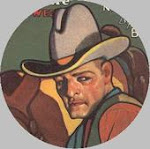

While reading a book, I’ll sometimes wonder what prompted the author to write it. Was there some event in the news that capture the nation’s attention? Was there a historical commemoration? Was a Broadway play, a song, or a movie popular in such a way that a writer wanted to ride its coat tails?
The question came to mind while reading Santa Fe Passage by Clay Fisher. I can’t say why I wondered—the Trail is a worthy setting for a novel.
The Trail’s timeframe normally is defined as 1821-1880—an important period bridging the early era of the United States’ establishing itself as a nation to the post-Civil War expansion and settlement of the western territories. The Trail also fueled the country’s economic growth, playing a part in the spread of the U.S. presence and influence westward and southwestward; and the flow of people and goods and money placed markers for future relations with Spain and Mexico. But on the whole, the Trail and its environs seem to be an era rarely explored by writers of traditional westerns (at least compared to the number of novels focused on the Wild West and Trail Drive periods of the nation’s history).
So I did a little research.

Santa Fe Passage was published in 1952 by Houghton Mifflin Company. It also appeared in the April 1952 issue of Esquire illustrated by pulp-and-slick stalwart Walter Baumhofer. Was anything happening in popular culture at the time that may have sparked the writing of Santa Fe Passage?
A Michael Curtiz film, Santa Fe Trail, starring Errol Flynn, Olivia de Havilland, Raymond Massey and Ronald Reagan, was released by Warner Brothers in 1940. A little early to have sparked a 1952 novel. A Randolph Scott movie, Santa Fe, was released in 1951 by Columbia Pictures. (Interestingly, Scott had been considered for the lead role in the 1940 film, Santa Fe Trail.) This movie was based on a novel by James Vance Marshall, Santa Fe: The Railroad That Built an Empire, published by Random House in 1945. It’s possible the book may have sparked an idea in Fisher’s creative mind, but more likely the Scott film did so.
Of course, there’s always the possibility Fisher just had a notion about a story independent of any other external stimuli. Clay Fisher is a pseudonym of the prolific Spur Award-winning Will Henry—a name that also is a pseudonym for Henry Wilson Allen. My general perception of a Will Henry novel is that it will be historically accurate and focus on a particular person, event, or thing—like the Santa Fe Trail—that carries some significance. This examined point of significance—what modernist poet Ezra Pound called the “barb of time”—allows Henry to build engaging, entertaining narratives in ways that may be said to elevate his tales from mere genre fiction (the “traditional western” label) to carrying the cachet of “historical fiction.”
Which doesn’t mean Santa Fe Passage doesn’t carry the tropes of melodrama. The story includes a hero, a villain (actually, more than one), romance, and violence.
Sounds like a traditional western, right? This one isn’t about the wild-and-woolly post-war West we expect in most traditional westerns—that is, those novels that fully conform to the genre tropes and expectations typically in place for those novels popularly known as Westerns. It is, instead, a novel set in the pre-Civil War era frontier. It takes place on the Santa Fe Trail—in fact, the characters do not even complete their journey and reach Santa Fe by the book’s end.
The tale focuses on a wagon train heading to Santa Fe from St. Louis. There are a number of conflicts—thanks to an unscrupulous wagon master, Kiowa raiders, terrible weather and bogs, to name only a few. One suspects Fisher pulled unfortunate events from every published history of the trail and crammed ‘em all into this single journey. Even if that is true, the travails have the feel of authenticity—particularly if one has also read some of the journals written by the Trail’s actual travelers. Fisher accomplishes the storyteller’s goal: the story is filled with incidents told at an interesting pace, making for an entertaining read.
The hero and his sidekick are Kirby Randolph and Sam Beekman, mountain men who’ve come east to civilization—in this case, St. Louis—after a long spell in the wilderness. They remind me a bit of the two male leads in David Thompson’s (David Robbins’) Wilderness series of books, Nathaniel King and Shakespeare McNair. Just as Thompson’s McNair teaches King how to survive and thrive in the frontier, Beekman attempts to mentor Kirby in the ways to live among civilized folks. Kirby’s attempts to shoehorn his oversized personality into the molds crafted by civilized expectations are sometimes humorous, sometimes deadly.
Fisher’s continual reliance on Mountain Main Idiom for Kirby and Beekman’s dialog is colorful but tiresome. David Thompson handles this much more successfully and satisfyingly in his Wilderness series. Here’s a sample from Santa Fe Passage:
<<
“Wal, if them mules is packin’ whut we heered they was, we should ought to have a reular guard commander. When the Kioways and Commanches get the wind of whut’s laced onto them longears, ye’ll have yer hands full jest bossin’, without yer tryin’ to run the camp guard, too.”
“Whut’s on them mules is Company business. I don’t know nothin’ about it. But I’m handlin’ the guard and if ye don’t like it, ye’d best haul out right now.”
>>
An interesting historical note: Santa Fe Passage is set in 1839. Part of the novel’s conflict arises from the transport of a woman—Aurelie St. Clair, Kirby’s eventual romantic interest—along the Trail. Women were few and far between on the actual Trail. For instance, the remarkability of one woman’s trip is documented in Down the Santa Fe Trail and into Mexico: The Diary of Susan Shelby Magoffin, 1846-1847 published in 1926. (Magoffin was long described as first woman to travel the trail, but more recent research [1984] by Marian Meyer has turned up documentation that another woman—Mary Donoho [like Magoffin, from Kentucky]—actually made the trip 13 years before Magoffin’s journey, earlier still than Fisher’s fictional passage. You can see my earlier blog post about this account by clicking here.)
I’m going to stray afield—or off-trail—for a bit and mention that Magoffin’s claim to the title of first “American lady” to travel the trail is somewhat spurious based on the cultural biases of the time (indeed, Meyer’s further investigations suggest Magoffin may actually have been the sixth woman): after all, she was accompanied by her maid, Jane, who may have been excluded from consideration because she was a servant, because she wasn’t white, or both. As Kelley Pounds points out in the online version of an article that first appeared in the January/February/March 1998 issue of Calico Trails, “Mary Donoho: The Santa Fe Trail’s New First Lady,”
<<
In Jean M. Burroughs' fictionalized account of Susan Magoffin's life, titled Bride of the Santa Fe Trail, Jane is portrayed as a black woman who had cared for Susan since childhood. If Burroughs' supposition is true, Jane might have been the first African American woman to travel the Santa Fe Trail all the way to Santa Fe. "Black Charlotte," wife of Dick Green and slave to Charles Bent, preceded Jane at least to Bent's Fort, where she worked as a cook in the early 1840s. According to David Lavender in Bent's Fort, published in 1954, Charlotte supposedly made the claim that she was the "only lady in de whole damn Indian country."
>>
You can read more of Donoho's essay by clicking here.
These historical notes aside, Santa Fe Passage remains an entertaining frontier tale. And as to its possible spark in Fisher’s mind—the question that kicked off this essay—I lean toward thinking it was the release of the Randolph Scott movie Santa Fe in 1951. (Randolph Scott . . . Kirby Randolph. Hmmm.) After all, Fisher—under his actual name of Henry Wilson Allen—worked as a screenwriter for MGM’s animation division. Santa Fe Passage was filmed and released by Republic Pictures in 1955, starring John Payne, Faith Domergue and Rod Cameron. It was directed by Republic stalwart William Witney. Interestingly enough, the script was by Heck Allen—another pseudonym of Henry Wilson Allen.


