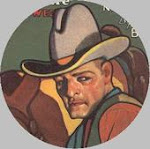
I've been entertained by the adventures of Thomas Buchanan for a few years now. I don't mean artist and blogger Thomas Buchanan, whose posts at The Pictorial Arts I find interesting, witty, and entertaining, and whose blog I recommend. I mean Buchanan, a series of peripatetic westerns published by Fawcett from 1956 to 1986 (meaning it lasted longer than Gunsmoke [1955 to 1975]), and written by diverse hands during that time.
So I was interested in reading other western series published by Fawcett. The company had published a number of solid and reliable series characters under its Gold Medal imprint in the hard-boiled spy/detective/thriller genres (notably Richard Prather's Shell Scott, Donald Hamilton's Matt Helm and Edward S. Aarons' Sam Durrell/Assignment series). With a deep catalog of western titles, and the long-running Buchanan series as a model, it made sense to me that GM would have more than one western series character.
I appealed to the collected brain trust at the Yahoo group moderated by James Reasoner, WesternPulps, and learned I was right. Although none of the series named in the responses lasted with as many entries as Buchanan, I was pleased to find out there are more GM western series to enjoy.
One of those series is about Amos Flagg, written by Clay Randall. While Buchanan's adventures were chronicled by a number of writers during his 30 years of activity, Flagg was the sole responsibility of Randall--a pseudonym of Clifton Adams, a reliable writer in the western and detective genres. Randall's career is detailed at Mystery*File here and here.
Flagg is the tough sheriff of Sangaree County, Texas. He is tough but fair, but he's driven to be unyielding by his family history: his father, Gunner Flagg, was a notorious outlaw. Now retired (ostensibly) from the owlhoot trail thanks to a long term in prison and old age, Gunner now lives in Sangaree County. His presence is a constant prod to his son that the sheriff must continually exceed the expectations of his constituents, who -- whenever they are disappointed by Amos' performing his duties --recall the adage that the apple doesn't fall far from the tree.
So far I've been able to get my hands on only the second entry in the series: Amos Flagg--High Gun. It's a solid western tale, well told, whose plot demonstrates the father-son conflict described above: Gunner, never far from a scheme, makes a deal with a writer/photographer from a big East Coast newspaper to interview Wild West outlaws whom Gunner has cajoled into gathering at a remote location. The plan goes awry, of course, and danger threatens the photographer, Gunner, Amos, the sheriff's closest friends, and eventually all of Sangaree County.
The build up is a bit slow, and -- to me, at least -- seemed to bog down a bit in the novel's middle portion. Things picked up about page 100 in this 160-page book. But my expectations were based -- probably wrongly -- on my experiences reading the Buchanan books. The entries in that series are fast paced, the characters quickly and deftly drawn, the situations lined out early and allowed to run like a galloping horse. For this Flagg novel, Randall delves a bit more deeply into the psychology of his characters, details the snares the sheriff must navigate in Sangaree County's political geography, and manipulates a much larger cast than one usually finds in a Buchanan caper.
Thinking about comments made by Ed Gorman on Randall's western writing, I've decided my initial dissatisfaction wasn't justified: Randall is a solid western writer, and High Gun is a tough, well-written western.
You'll find a listing of Clay Randall's Gold Medal output at Eddie Stevenson's Gold Medal-focused site, here. You can read another review of High Gun at Cullen Gallagher's Pulp Serenade. (He also posts a second cover painting for the Belmont Tower edition of the novel, which pictures an unmistakable likeness of Clint Eastwood as Amos Flagg. I've posted both it and the GM cover to accompany this post. Having two icons linked with the western (model Steve Holland on the GM edition, Eastwood on the BT edition) on two editions of the same book certainly is a fine honor for a western novel, I'd say.
Randall gets high marks at Pulp Serenade. I second the opinion. I'll be searching out more Amos Flagg novels.
Showing posts with label James Reasoner. Show all posts
Sunday, February 3, 2013
Saturday, April 23, 2011
Redemption, Kansas by James Reasoner
Redemption, Kansas by James Reasoner delivers just what I expect from any book by James: a well-told story, likable characters who are a pleasure to meet, vicious characters who are a joy to despise, action, and humor.
James has written more than 400 stories in a variety of genres, and the easy flow of this narrative demonstrates his storytelling mastery. This tale of a Texas drover injured during a trail drive and left in the small Kansas town of the title to recover provides a nice mix of the elements that mark a solid traditional western: a strong hero who can’t ignore the difference in right and wrong simply because that would be the easy thing to do; a town cowed by a tyrannical lawman; truly evil outlaws; a pretty heroine to win; a conflict between cultures (the cow-driving Texans and the settled Kansas townies); gunfights.
Bill Harvey is still a boy when he’s injured during a cattle drive stampede, caused by a rustler’s nighttime attack on the herd. But he finds his way as a man during his recuperation in Redemption, as he bucks the locals’ biases against wild-and-woolly Texans.
That there’s also a mystery about back-shot citizens hanging a pall over the town simply adds to the drama that brings together Bill with Eden Monroe. James performs marvelously as he builds the relationship between these two characters, not rushing, forcing or artificially combining the details about their growing respect and love for one another.
There’s also the well-constructed villain — one of several who appear in this book — who sets off the chain of events leading to Bill’s injury: Dock Rakestraw has a great name to go along with his mean spirit and evil ways.
I’ve yet to be let down by a Reasoner novel. I’m already looking forward to reading the next one.
Thursday, March 31, 2011
Berkley's westerns
When Dorchester announced it would cease publishing printed books, I was really
surprised. A genre publisher with a big footprint—at least in the stores and I
libraries I frequent—was going to cease business as usual and go the eBook route
only.
For me, that meant I wasn’t going to see a lot—or any—of the pulp authors back
in print that Dorchester—under its Leisure Books imprint—had published the past
few years, Max Brand (Frederick Faust) in particular. While Brand had never
gone completely out of print, Leisure was instrumental—greatly by the work of
Jon Tuska—in returning names like T.T. Flynn, Robert Horton, Dan Cushman, Dane
Coolidge, and others to the bookshelves.
Sure enough, as I write this, six months after Dorchester ended its print runs,
none of their products are to be found on the retail shelves in my community.
What I find are westerns from Pinnacle/Kensington (primarily the William
Johnstone series), Bantam (really, only Louis L’Amour), and Signet (a number of
authors). I’m not sure if HarperCollins is still publishing westerns—I don’t
recall seeing any recently.
The local WalMarts carry very few westerns, only the Johnstone titles. Kroger
carries Johnstone and the Signets (mostly Ralph Cotton and the ghosted Ralph
Comptons), and a handful of L’Amour titles. The local chain bookstores carry
these same authors, for the most part, although the selection seems to end with
author names starting with L (for L’Amour), because there aren’t any other
titles on the shelves after the string of Bantam L’Amours, unless the store
carries the Trailsman series.
But I noticed recently that I rarely if ever saw any westerns from Berkley on
the shelves—and I know they’re publishing westerns, because James Reasoner just
had a new book published by that house.
So I went searching. Apparently no one in town is selling Berkley westerns. I
have to order them online. (Okay, I take that back--the stores are selling the westerns written by Robert B. Parker and published by Berkley. But he's the only Berkley western writer I saw.)
The local lack of availability seems odd to me, because Berkley is part of a big
combine, Penguin Books.
So I decided to hunt down some Berkley westerns and read a few. Upcoming posts
will take a look at those books.
Labels:
James Reasoner,
Les Savage,
Robert Parker,
T.T. Flynn
Sunday, March 20, 2011
Bill Crider reviews Pretty Polly
Another Texas gentleman, Bill Crider, has posted a positive review of Pretty Polly at his blog, Bill Crider's Pop Culture Magazine.
Bill is an accomplished author in the crime and western genres. He writes the Sheriff Dan Rhodes mystery series. He's written some excellent westerns: Two of my favorites are Outrage at Blanco
and Texas Vigilante
, both about a female gun-for-hire--the story is tough and action-filled, and the prose thrums with that masculine energy that marked the best Gold Medal westerns of the 1950s and '60s.
Bill also is one member of the triumvirate of authors behind the new Rancho Diablo series of novels. The other two writers are James Reasoner and Mel Odom, and the three are penning these western tales under the shared pseudonymn of Colby Jackson. An interview with Bill about the series is available at the Pulp Serenade blog.
Bill is an accomplished author in the crime and western genres. He writes the Sheriff Dan Rhodes mystery series. He's written some excellent westerns: Two of my favorites are Outrage at Blanco
Bill also is one member of the triumvirate of authors behind the new Rancho Diablo series of novels. The other two writers are James Reasoner and Mel Odom, and the three are penning these western tales under the shared pseudonymn of Colby Jackson. An interview with Bill about the series is available at the Pulp Serenade blog.
Tuesday, March 15, 2011
Review of Pretty Polly
Texas gentleman James Reasoner has posted a positive review of Pretty Polly
over at his blog, Rough Edges.
James is a fine writer with more than 200 books to his credit, and more to come. Everything I've read by him has been entertaining. One of my favorites is Under Outlaw Flags
, which combines the western with World War I action.
He has two recent releases:
One is a western, Rancho Diablo #2: Hangrope Law, under the pseudonym Colby Jackson. Jackson is a name shared by three writers--Mel Odom, Bill Crider, and James--who are writing a western series they've created under a single nom de sixshooter. They are releasing the Rancho Diablo series as eBooks for the Kindle and the Nook.
His second new release is from Berkley, Redemption, Kansas. It's available both as a paperback and an eBook. Troy D. Smith has a nice review of Redemption, Kansas, over at the Western Fictioneers blog.
James' review of Pretty Polly suggests that the villain, Griswold Bear (aka Grizzly or Grisly, depending on whom your talking to), should make a return appearance. I have to admit I hadn't thought about that. I fully expect Sheriff Shoat to show up in another story, but maybe Griswold also deserves another fictional outing. I'll have to let that percolate in the brain pan. It's worth considering.
James is a fine writer with more than 200 books to his credit, and more to come. Everything I've read by him has been entertaining. One of my favorites is Under Outlaw Flags
He has two recent releases:
One is a western, Rancho Diablo #2: Hangrope Law, under the pseudonym Colby Jackson. Jackson is a name shared by three writers--Mel Odom, Bill Crider, and James--who are writing a western series they've created under a single nom de sixshooter. They are releasing the Rancho Diablo series as eBooks for the Kindle and the Nook.
His second new release is from Berkley, Redemption, Kansas. It's available both as a paperback and an eBook. Troy D. Smith has a nice review of Redemption, Kansas, over at the Western Fictioneers blog.
James' review of Pretty Polly suggests that the villain, Griswold Bear (aka Grizzly or Grisly, depending on whom your talking to), should make a return appearance. I have to admit I hadn't thought about that. I fully expect Sheriff Shoat to show up in another story, but maybe Griswold also deserves another fictional outing. I'll have to let that percolate in the brain pan. It's worth considering.
Sunday, December 19, 2010
Rancho Diablo: Hangrope Law
James Reasoner has a new western novel, Hangrope Law, now available as an original e-book for the Kindle. You can learn more about it at James' blog, Rough Edges. James' novels are always entertaining, and I'd like to see this new series he's kicked off for the eBook market with Mel Odom and Bill Crider sell well.
Labels:
Bill Crider,
James Reasoner,
Mel Odom,
Rancho Diablo
Saturday, February 20, 2010
Max Brand, King of the Spaghetti Westerns
Our pal James Reasoner, a fine writer of westerns and crime fiction, has a nice blog named Rough Edges. In a recent post, he reviews an indie film, Shoot First and Pray You Live. This is apparently based on a Frederick Faust/Max Brand novel serialized in 1919 in Argosy, Luck, which later was published in book form as Riders of the Silences. One of the comments to James' post notes that Brand gets no credit for the story -- which really isn't surprising, as the novel's 1919 publication date puts it in the public domain.
James notes that the film is very faithful to Brand's novel, even though the title sounds like it came from a spaghetti western, and "it made me realize for the first time that what Faust was doing, decades before the genre was even invented, was writing the literary equivalent of Spaghetti Westerns."
Makes sense. I've said somewhere or to someone before that Brand's westerns are true horse operas -- bigger than life, played on a large stage. And Faust loved that kind of storytelling, as his biographies point out his love of Shakespeare and The Faerie Queene. He lived in the home of the spaghetti western for years in a villa -- it really makes sense that perhaps with The Good, the Bad, and the Ugly, Sergio Leone was simply putting on film the sort of story that Faust had been hammering out for popular consumption decades earlier.
Subscribe to:
Posts (Atom)


