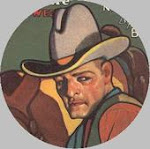
The Trail of Whitened Skulls: The Cole Lavery Saga, by Tom W. Blackburn (Waterville, Maine: Five Star), 2006.
Cowboys! That’s what I wanted to read about by the end of last year. By the time the holiday season arrived I was ready for a cowboy-reading binge. So I started with a recent collection published by Five Star,
The Trail of Whitened Skulls: The Cole Lavery Saga, by Tom W. Blackburn. To my knowledge, this is the first work by
Blackburn I’ve read.
It’s quite good, and I recommend it. Five stories plus an informative
Foreword by Jon Tuska. Blackburn lends a nice sense of history and authenticity to his tales by including appropriate details along with the characters’ awareness of their place as players in a larger tide of life.
For example, at one point Cole thinks, “The country was in Marta’s blood as it was in his, then. Time was the thing they had. Out of time and a little courage and a bright hopefulness, anything could be built.” (“Trail of Whitened Skulls,” 149) From a strictly critical aspect, such thoughts might seem sentimental, anachronistic or post-modern, but passages such as this lift these stories from mere action yarns to solid mainstream entertainment. They are the sort of messages one finds built into the western stories of Louis L'Amour and the western films of John Ford.
This sense of history and a character's place within its march is probably a good reason Blackburn was tapped to work on certain TV shows with historical settings, such as Walt Disney's
Davy Crockett and
Johnny Tremain,
Daniel Boone,
The Virginian,
Maverick,
Cheyenne, and others.
For Christmas I received from my brother the February 1949 issue of
Zane Grey’s Western Magazine, which coincidentally included another Blackburn story, “Mother Lode Mutiny.” This tale is set in a California gold camp, where a trouble-shooter — similar in some ways to Cole Lavery — cuts his way into the success of a town by outsmarting a greedy, under-handed villain. Again, Blackburn imparts a sense of historical authenticity with details that place its fictional drama within the context of larger actual events.
This sense of historicity is apparently an element Blackburn included in his work throughout his career. He wrote a number of scripts for TV westerns and for various incarnations of Walt Disney's television show, including
The Saga of Andy Burnett and
Davy Crockett and the River Pirates. Considering this latter item, Blackburn also gets writing credit for "
The Ballad of Davy Crockett" -- which has taken its place among the nation's folksongs.
You can find the paperback edition of
The Trail of Whitened Skulls at Amazon.com by clicking
here.


 Posts
Posts