Sunday, February 3, 2013

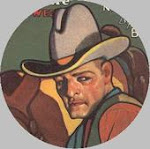
Clay Randall's Amos Flagg--High Gun

I've been entertained by the adventures of Thomas Buchanan for a few years now. I don't mean artist and blogger Thomas Buchanan, whose posts at The Pictorial Arts I find interesting, witty, and entertaining, and whose blog I recommend. I mean Buchanan, a series of peripatetic westerns published by Fawcett from 1956 to 1986 (meaning it lasted longer than Gunsmoke [1955 to 1975]), and written by diverse hands during that time.

So I was interested in reading other western series published by Fawcett. The company had published a number of solid and reliable series characters under its Gold Medal imprint in the hard-boiled spy/detective/thriller genres (notably Richard Prather's Shell Scott, Donald Hamilton's Matt Helm and Edward S. Aarons' Sam Durrell/Assignment series). With a deep catalog of western titles, and the long-running Buchanan series as a model, it made sense to me that GM would have more than one western series character.

I appealed to the collected brain trust at the Yahoo group moderated by James Reasoner, WesternPulps, and learned I was right.  Although none of the series named in the responses lasted with as many entries as Buchanan, I was pleased to find out there are more GM western series to enjoy.

One of those series is about Amos Flagg, written by Clay Randall. While Buchanan's adventures were chronicled by a number of writers during his 30 years of activity, Flagg was the sole responsibility of Randall--a pseudonym of Clifton Adams, a reliable writer in the western and detective genres. Randall's career is detailed at Mystery*File here and here.

Flagg is the tough sheriff of Sangaree County, Texas. He is tough but fair, but he's driven to be unyielding by his family history: his father, Gunner Flagg, was a notorious outlaw. Now retired (ostensibly) from the owlhoot trail thanks to a long term in prison and old age, Gunner now lives in Sangaree County. His presence is a constant prod to his son that the sheriff must continually exceed the expectations of his constituents, who -- whenever they are disappointed by Amos' performing his duties --recall the adage that the apple doesn't fall far from the tree.

So far I've been able to get my hands on only the second entry in the series: Amos Flagg--High Gun. It's a solid western tale, well told, whose plot demonstrates the father-son conflict described above: Gunner, never far from a scheme, makes a deal with a writer/photographer from a big East Coast newspaper to interview Wild West outlaws whom Gunner has cajoled into gathering at a remote location. The plan goes awry, of course, and danger threatens the photographer, Gunner, Amos, the sheriff's closest friends, and eventually all of Sangaree County.

The build up is a bit slow, and -- to me, at least -- seemed to bog down a bit in the novel's middle portion. Things picked up about page 100 in this 160-page book. But my expectations were based -- probably wrongly -- on my experiences reading the Buchanan books. The entries in that series are fast paced, the characters quickly and deftly drawn, the situations lined out early and allowed to run like a galloping horse. For this Flagg novel, Randall delves a bit more deeply into the psychology of his characters, details the snares the sheriff must navigate in Sangaree County's political geography, and manipulates a much  larger cast than one usually finds in a Buchanan caper.

Thinking about comments made by Ed Gorman on Randall's western writing, I've decided my initial dissatisfaction wasn't justified: Randall is a solid western writer, and High Gun is a tough, well-written western.

You'll find a listing of Clay Randall's Gold Medal output at Eddie Stevenson's Gold Medal-focused site, here. You can read another review of High Gun at Cullen Gallagher's Pulp Serenade. (He also posts a second cover painting for the Belmont Tower edition of the novel, which pictures an unmistakable likeness of Clint Eastwood as Amos Flagg. I've posted both it and the GM cover to accompany this post. Having two icons linked with the western (model Steve Holland on the GM edition, Eastwood on the BT edition) on two editions of the same book certainly is a fine honor for a western novel, I'd say.

Randall gets high marks at Pulp Serenade. I second the opinion. I'll be searching out more Amos Flagg novels.


Friday, January 25, 2013

Strong stuff: Edge and the Piccadilly Western

Recently a co-worker said to me, "You made the coffee this morning."

"How do you know?"

"I added cream and it didn't change color."

I nodded. "Strong stuff."

Strong stuff is what I've encountered not only in my beverages but also in my reading lately.

I've recently read the first Edge novel and the second entry in that long-lived series. (The first Edge novel, The Loner, was published in 1971. The last entry in the series was published in 1989. I'm just now getting around to it. I'm more like the tortoise than the hare.) Famously and accurately blurbed as "The Most Violent Westerns in Print!" Any virtues (and there are very few) the other characters exhibit are overshadowed by the primary character's apparent amorality.

Edge starts out as Josiah Hedges, returned from the War Between the States to find his younger brother tortured and murdered. He sets out on a vengeance trail. Hardened by war and heartbreak, Edge is a killing machine, cold and ruthless.

Fashioned to take advantage of the surge of popularity in the Spaghetti Western films of the time, the Edge series features a lot of hard-boiled, ugly characters in noirish situations. Author Terry Harknett -- working under the George Gilman pseudonym -- writes a sharp-paced, snappy narrative with flares of black humor. But the entries I've read have a far stretch to go before reaching the epic and nuanced development of Sergio Leone's The Good, The Bad, and The Ugly or even My Name is Nobody.

Edge and most of the other Piccadilly Cowboy westerns were nearly all published with a distinctive cover design, an easily recognizable style of cover paintings that helped readers quickly see that here was a book similar in mood and graphic violence like others published by New English Library (or, in the U.S., Pinnacle or Chelsea House). The covers and the packaging are attractive, and it's easy to see why readers were first tempted to purchase these books when they initially appeared. 
 
The violent-action thrillers set in a contemporary setting that would have been the counterparts of the Piccadilly westerns would have been Don Pendleton's Executioner series. But from a purely packaging and marketing standpoint, I'd say the Piccadilly westerns had the upper hand.
 
I also recently read the second entry in the Jubal Cade series, Double Cross, which was contemporaneous with the Edge series, and also penned by Terry Harknett and Angus Wells, who belonged to the Piccadilly Cowboys. Jubal Cade is another ruthless character. However, he debates with himself the appropriateness of his actions: he was trained to be a physician, to heal people; but he will take a life as quickly as stomping a bug if that person thwarts or threatens his plans. This debate is highlighted in the novel I read when he shot and wounded an attacker, then was captured by the attacker's brother, and had to tend to the wounded man's injuries. Hard-boiled, just like the Edge books, but with a glimmer of morality at least visible between the lines.

But there are few glimmers for hope, optimism, or morality in the Edge books. He takes the wandering antihero figure fashioned by Leone and Clint Eastwood to what may be its most extreme depiction in western series fiction. Edge is deadly, misogynistic, focused purely on self preservation -- as if his lizard brain is the only functioning part of his mind.  Perhaps most telling about Edge is this description in the second book: "He was a man without imagination."

Strong stuff has its place. But for me, a little reading of this type goes a long way. I think the next western book on my reading list will veer back more to the traditional mode.

Saturday, September 1, 2012

Down the Santa Fe Trail and into Mexico: The Diary of Susan Shelby Magoffin, 1846-1847

In an earlier post I discussed my appreciation for the University of Nebraska Press' Bison Books imprint.

One of the Press' books I read recently was Down the Santa Fe Trail and into Mexico: The Diary of Susan Shelby Magoffin, 1846-1847. I have some interest in the Santa Fe Trail, and when I found this volume on the library's Sale cart, I thought it would be a handy reference.

Well, it is, But when I began reading it, I had no idea I was also going to be immersed in lots of Kentucky history, as well.

Susan Shelby Magoffin (July 30, 1827 – October 26, 1855) was tied to two families important to frontier history. Really, more than two.

She was the granddaughter of Isaac Shelby (December 11, 1750 – July 18, 1826), a hero of the American Revolution and the first and fifth governor of Kentucky. She was born near Danville, Kentucky. She was named for an aunt, who was married to Dr. Ephraim McDowell  (November 11, 1771 – June 25, 1830), a Danville physician famed for performing the world's first successful ovarian tumor removal by surgery. (The tumor weighed 22.5 pounds!)

At the time of the journey, Susan was 18 years old and had been married only eight months to frontier merchant Samuel Magoffin, whose family also hailed from Kentucky. One of Susan's sisters was married to Beriah Magoffin, 21st governor of Kentucky. Samuel's brother – and Susan's brother-in-law – James played an important role during the journey recounted in Susan's journal, serving as an emissary of the United States government to deal with the Mexican authorities as the Army advanced—because, while the Magoffins made their business trek to Santa Fe, the U.S. Army was battling the Mexican Army in efforts that would eventually expand the United States' border to the Rio Grande to include he Republic of Texas and New Mexico.

So Susan met another famous Kentuckian on her trip: Zachary Taylor (November 24, 1784 – July 9, 1850), General of the Army at the Battles of Monterrey and Buena Vista, afterwards known as Old Rough and Ready, and eventually elected as the 12th President of the United States.

Susan is quite proud of her Kentucky heritage, and she continually compares the men she meets during her trip with the Fine Kentuckian Qualities of the men she knows back home. For example, while in Santa Fe . . .

On leaving the Fort we rode to the opposite side of the city (to the West) to see the Gloriatta, an inclosed public walk. It was commenced by Gov. Gen. Garcia Conde, being planted altogether in indifferent looking Cotton-woods it is quite susceptible of improvement—a Yankee's ingenuity and Kentuckian's taste is wanting to make it a beautiful place. (pp. 141-142)

While in Santa Fe, she is visited by a number of the military men. To one such visitor, Susan says,

I complimented him a little and my own dear Kentucky, at the same time by asking him, for my own private information, if he [came] from Ky. as I believed most or all of the great men were from there, or connected with her in some way. (132)

Susan's allegiance to her home state sound a bit funny to our ears. But really, people today have local and state pride; and the boosters of college sports teams aren't so much different today. (SEC fans may be a bit more zealous.) But her biases aside, her journal provides a remarkable record of the time for a civilian caught in a war zone while the U.S. invades Mexico. The worries – for loved ones captured or for her immediate family, when rumors reach them that the enemy is approaching and killing all Anglos – and the delights of her journey are presented with details that military and business-oriented accounts overlook or have no concerns for. The details of the journey – the number of hours of travel, the stops for water or rest or repairs, the description of the landscape and its features, the difficulties of living on the trail – are wonderful for those who seek that sort of information, and her descriptions lift the Santa Fe Trail from being a dry historical subject to something alive and real.

Susan's place in history as the first Anglo woman to travel the Trail and journey into Mexico with the traders is made all the more important by her journal, which gives the modern reader a look at the War with Mexico, a wonderful view of travel and work on the Sante Fe Trail, and a sense of what people from North American culture experienced when they first encountered the South of the Border culture during the 1840s.

I heartily recommend this book.


Saturday, August 4, 2012

Riker's Gold by Skeeter Dodds

I picked up this novel wondering what kind of western writer someone named Skeeter might be. Checking the copyright page, he's apparently actually James O'Brien. I gargled the Internet and came up with nothing about this particular writer.

Riker's Gold was originally published as a Black Horse Wester in 2001. I read the large print edition published in the Dales Western Library.

I thought I would be in for a long, slow read when the novel opened with Jack Riker bemoaning the bad times: his once-fruitful farm has hit bad times, as the past few years have brought drought and a failing future to Riker and his wife, who has turned rather bitterly against him as well.

Then a soldier comes by and leaves behind saddle bags full of Army gold for Riker's safekeeping. The soldier is sick with a fever that has wiped out the rest of his company. He wants Riker to hold onto the gold until the Army sends someone looking for the lost troop. Then the soldier rides into the snow-covered mountains to die.

A band of thieves come across the soldier's trail and follow him into the mountains. They see him scribble a note, then fall over dead. Overcoming their fear of the illness that's claimed all the dead soldiers lying about, they take possession of the note and read about the gold and its whereabouts.

Meanwhile, Jack has ridden into town to lock the saddlebags in the safe within the sheriff's office. Jack is part-time lawman for the town. After a rattling argument with his wife, who wants him to simply take the gold and start a new life, Riker thinks the gold will be safer hidden in town until the Army shows up. But a nosey townsman peeps through the office window and sees Riker locking away the saddlebags, which raises his curiosity. The fellow is a known lush, and the wily bar owner can tell something is on the man's mind. Lubricating the gent with free drinks, he learns about the hidden saddlebags and wonders why Riker would make the effort to secure them.

The barowner has kept a long-simmering feud going with Riker, because he hankers for Riker's wife. When he learns the sheriff's safe holds gold, he stirs up the townspeople – who, like Riker, are beaten down by bad times – in a scheme to get the gold and Riker's wife, too. The conflict boils over when the deadly gang of thieves arrive in town, and the shooting begins.

Dodds uses the love triangle effectively in this story, building a range of conflicts from that emotional dynamic coupled with Riker's ethical dilemma about how to handle the gold placed in his care. Although there are plenty of characters willing to fire guns in this tale, Dodds plays a wary game with his primary character, Riker, by having the sheriff keep gunplay at bay until the final town-sized shootout that brings the story to a climax. Dodds handles this nicely.

I was intrigued enough by Riker's Gold to wonder how the author might handle another plot. I'll have to find out.